
Demand for sewing skills has grown, but fewer people are stepping into the career
By Associated Press
Published: April 11, 2026, 6:04am
NEW YORK — Hunched over a sewing machine, Kil Bae is hemming a dress inside his Manhattan tailor shop when a new customer stops by with a vintage Tommy Hilfiger jacket he wants taken in.
The modeling agent paid $20 at a thrift store for his reversible bomber-style coat that’s plaid on one side and red on the other. He’s willing to spend $280 to have it slimmed down. Alteration requests with such a price disparity would have seemed odd a few years ago, the tailor says, but are helping to keep the bobbins bobbing at his one-man shop, 85 Custom Tailor.
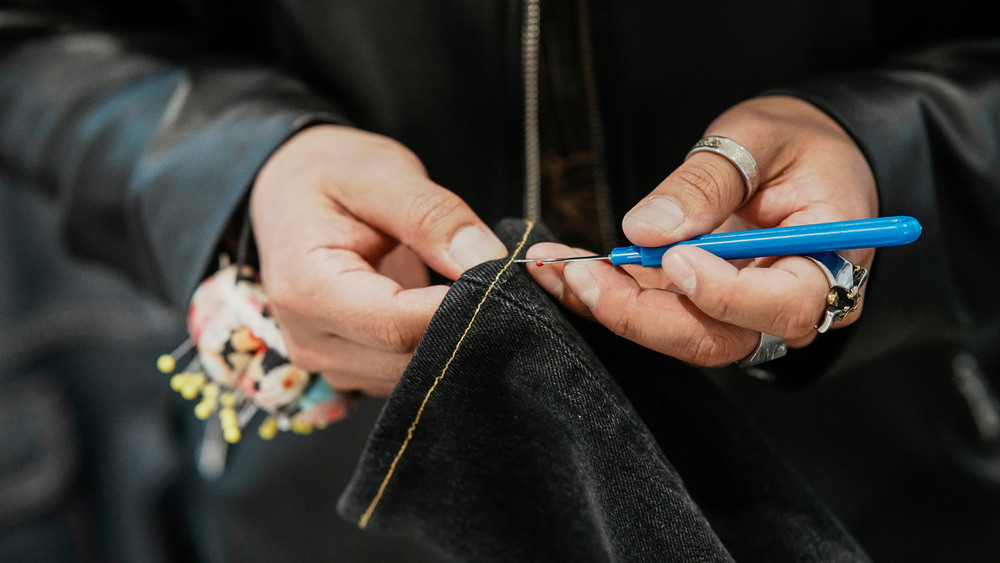
Bae carefully examines the cotton jacket before moving in to pin it, circling the customer like a sculptor with a chisel. He started training as a tailor at age 17 in his native South Korea. Now 63, he’s part of a shrinking breed in the United States, where professional sewers, dressmakers and tailors are aging out of the workforce as their services find fresh demand.
Shoppers who grew up on disposable fast fashion are enlisting tailors and seamstresses to give off-the-rack purchases a custom fit or personal flair, to revive secondhand finds or to extend the lives of their wardrobes, according to fashion industry experts. Weight-loss drugs like Zepbound and Wegovy mean more Americans are seeking adjusted waistbands, tapered sleeves and other types of resizing, Bae said.
“I recommend this job to young people because this one cannot be AI’d,” Bae said, noting artificial intelligence is automating pattern making but so far can’t replicate a tailor’s handiwork. “Different bodies. Different shape. They cannot copy like this.”
But like engraving, repairing musical instruments and many other skilled trades, creating and fitting garments to individual specifications hasn’t attracted enough entry-level workers over the years to replace the professionals retiring their pincushions after decades of performing their craft.
An aging occupation
The U.S. Bureau of Labor Statistics estimated almost two years ago, there were fewer than 17,000 tailors, custom sewers and dressmakers working in business establishments nationwide, a 30 percent decline from a decade earlier.
Including self-employed individuals and people working in private households, the median age for all sewers, dressmakers and tailors was 54 last year, 12 years older than the median for the entire employed population, according to the bureau.
The income that a proficiency with needle and thread commands relative to the skills needed and the physical toll of bending over detailed work for hours likely discourages teenagers and young adults from heeding Bae’s advice, fashion industry experts said.
The mean annual wage that tailors, dressmakers and custom sewers earned as of May 2024 was $44,050 a year, compared to $68,000 for all workers, according to BLS calculations.
“Most of fashion training is really aimed at mass production, not spending time in a shop handmaking a garment,” said Scott Carnz, the provost of LIM College, a for-profit college that offers degrees in disciplines from the business side of fashion. “The work is also tedious.”
Online job postings for tailors, dressmakers and sewers have remained fairly stable, according to Cory Stahle, an economist with the research arm of jobs site Indeed. Between February 2020 and the end of the same month this year, advertised openings decreased by roughly 2 percent, while postings for both marketing and software jobs declined by nearly 30 percent, he said.
“There is a kind of a craftsmanship … that I think is an important piece that we can’t ignore,” said Stahle, who focuses on the U.S. labor market.
Skilled immigrants
Immigrants with and without permanent legal status, refugees and naturalized citizens have powered America’s garment industry for well over a century.
An analysis of recent census data by the Migration Policy Institute found about 40 percent of tailors, dressmakers and sewers were foreign-born, according to Julia Gelatt, associate director of the nonpartisan think tank’s U.S. Immigration Policy Program. The biggest shares came from Mexico, South Korea, Vietnam and China, she said.
To address a worsening labor shortage, the fashion industry is looking to create a new generation of master tailors.
Nordstrom, North America’s largest employer of tailors and alteration specialists, teamed up with New York’s Fashion Institute of Technology to launch a nine-week program in advanced sewing and alteration techniques.
“Customarily, tailoring has never been part of the American skill set,” said FIT instructor and Broadway costume builder Michael Harrell, who teaches the course.
A growing market
The fashion institute received 200 applications for the inaugural cohort of 15 students, who started in October and received certificates of completion in February, said Jacqueline Jenkins, the executive director of the school’s Center for Continuing and Professional Studies.
The hands-on training was designed to prepare participants to work at Nordstrom. The luxury department store chain employs 1,500 people to provide tailoring and alternations, from hemming jeans and repairing rips to fitting suits and reworking evening gowns.
Ten members of the first class were hired or are in the process of being hired, said Marco Esquivel, Nordstrom’s director of alterations.
“We owe it to the broader industry to ensure that this is an art form that exists for years and years to come and continues to serve customers,” Esquivel said.